The study can be downloaded on Via Medica site. The authors has analysed statistical data as is, but conducted no experiments to check, if there’s a causation, so it need to be assumed, all results are based on correlation.
Gender
The results about the gender are the most disturbing. The occurrence of DCS was 3.289 times higher in females than in males. Such a bit difference is hard to explain with correlated factors. Scuba dive industry is focused on men, lighter tanks, like 10 liter mono or double 7, are unavailable in most diving centers, which put more pressure on women’s bodies. Women has on average more body fat, but the study suggests the inverted role of that factory. Women has different metabolism than men, and this factor should definitely be studied more intensively by dive computers manufacturers.
BMI
The results are very surprising. They suggest, that moderate obesity actually reduces the risk of DCS:
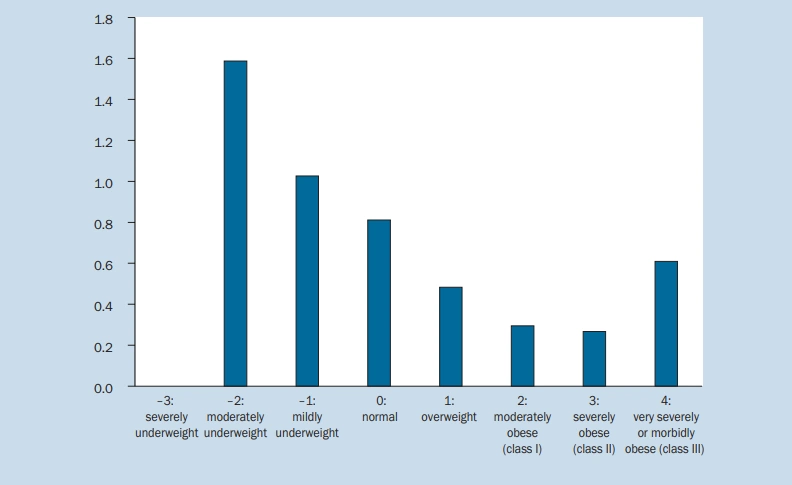 However, we should be very careful evaluating that data. Since long time dive science accents the increased risk of DCS connected with obesity, and recommends obese people to use more conservative gradients. On the other hand, better fitness is considered to be the factor allowing more aggresive profiles. It’s reasonable to assume, most people dive according to that recommendations. Obese people use conservative gradients, which lower the risk of DCS, while very fit/lean people use aggresive gradients, which put them on risk. On many computers (Garmin, Suunto) the most aggresive settings produce more aggresive dive profiles than when using raw Bühlmann.
Thermal comfort
This is very surprising. According to the study, the increase in thermal comfort, from cold to comfort and hot, was positively associated with DCS risk, with a factor of 2.8. This is contrary to what most people believe: that cold increases risk of DCS. The possible explanation is, that thermal comfort increase the blood flow, increasing the saturation rate, especially in limbs. It’s interesting, if bubbles are more likely to start forming in limbs, and their formation is less likely in cold water by decreased blood flow. It’s certainly a great area for future medical studies.
Exercise before diving
Exercise is considered to be a risk factor for DCS, but it was based mostly on anegdotical evidente. This study provides statistical evidence, confirming that exercise before the dive increased the risk of DCS twice. There’s, however, lack of diversification between intense workout, warmup, and carrying equipment. It’s not clear, if it’s the muscle workout itself, or increased thermal comfort resulting from increased heat production before dive, that is a significant factor there.
Workload during dive
Workload during dive, for example diving against current, or speed diving, or wearing very heavy equipment, was confirment to increase DCS by factor of 1.6.
Technical diving
Diving in technical configuration, diving with multiple gas mixtures or with additional tanks is correlated with higher DCS risk. This is not surprising, because such configurations are more often used for decompression diving than for recreational null-time dives.
Conclusion
We need to accent once again, this is the statistical analysis of existing data. No experiments were concluted to check causality. All results are based on correlation. Some factors correlate, for example more tanks mean more workload before and during the dive, and most likely more thermal comfort. Being female means usually having equipment weighting more in relation to your body weight than in case of men, which means heavier workload. However, the risk factor of being woman is higher than with other factors, and is unlikely to be explained only with them. Studying the difference of male and female body in context of DCS should be the focus point of subsequent studies in the science of diving.
You can watch video analysis of this study here: